Keep the key numbers in mind throughout: common repairs run $75-$300; complete new openers, installed and programmed, run $350-$850.
In This Guide
Key Takeaways
- If the repair costs more than half of a comparable new opener installed, lean replacement.
- Openers built before 1993 lack the photo-eye safety systems federal law has required since — any such unit should be replaced on safety grounds alone, whatever it costs to repair.
- Battery backup is the headline: the door keeps working through outages — required by law for new installs in some states, and the feature owners praise most after the fact.
- Here is the diagnosis that protects the money: disconnect the opener and lift the door by hand.
- Ask for the repair quote and the replacement quote together, installed prices, warranties stated.
- Walk this list against your unit: photo-eye sensors (mandatory since 1993 — if absent, replacement isn't a preference, it's a safety correction).
- A complete opener replacement includes removal and disposal of the old unit, the new motor and rail, both safety sensors fitted and aligned, a wireless keypad programmed, remotes for your vehicles, smartphone setup if the model supports it, travel and force calibration, and demonstrated safety tests.
- Between 'repair it' and 'replace it' sits a middle shelf worth knowing.
How to use this guide: find your situation in the tables, note the fair range, then compare it line by line with any quote you receive — including ours. If a number falls outside the ranges here, the right response isn't panic; it's one question: 'what's different about my door?' A good company answers it in specifics — door weight, part specification, timing — and a vague answer is itself the answer. When you're ready for an exact figure, call (210) 964-8892: our quotes are flat, written from the same data as this guide, and confirmed before any work begins.
Test 1: The Half-Cost Rule
If the repair costs more than half of a comparable new opener installed, lean replacement. A $260 board on a unit whose modern equivalent installs for $450 buys you an old motor, old rail and no warranty for 58% of the price of everything new. Conversely, a $120 gear kit on a 7-year-old opener is exactly the repair the half-cost rule blesses: modest money, years of remaining service.
Count the whole repair honestly — if the unit needs a board now and its gear is visibly worn, that's one combined future, not two separate bargains. Technicians see the whole unit; ask them to.
Test 2: Age and the Safety Line
Openers built before 1993 lack the photo-eye safety systems federal law has required since — any such unit should be replaced on safety grounds alone, whatever it costs to repair. Units from the 1990s-2000s with fixed-code remotes carry a real security weakness (codes can be captured and replayed) that rolling-code modern units eliminate.
Practically: under 10 years old, repair freely; 10-15 years, apply the half-cost test strictly; over 15 years, replacement should win ties, because the next failure is already in line behind this one and the feature gap (below) is now enormous.
Test 3: What a New Opener Actually Adds
Battery backup is the headline: the door keeps working through outages — required by law for new installs in some states, and the feature owners praise most after the fact. Built-in Wi-Fi adds phone control, open-door alerts and scheduled auto-close; in homes where the garage door is the main entrance, the 'did I close it?' notification alone justifies it for many families.
Belt-drive quiet matters if living space touches the garage. LED lighting is brighter and permanent. DC motors with soft start/stop are gentler on the door hardware, extending the life of everything attached. None of these are gimmicks — they're the accumulated difference between 2008 and 2026 engineering.
Before Either Decision: The Door Test
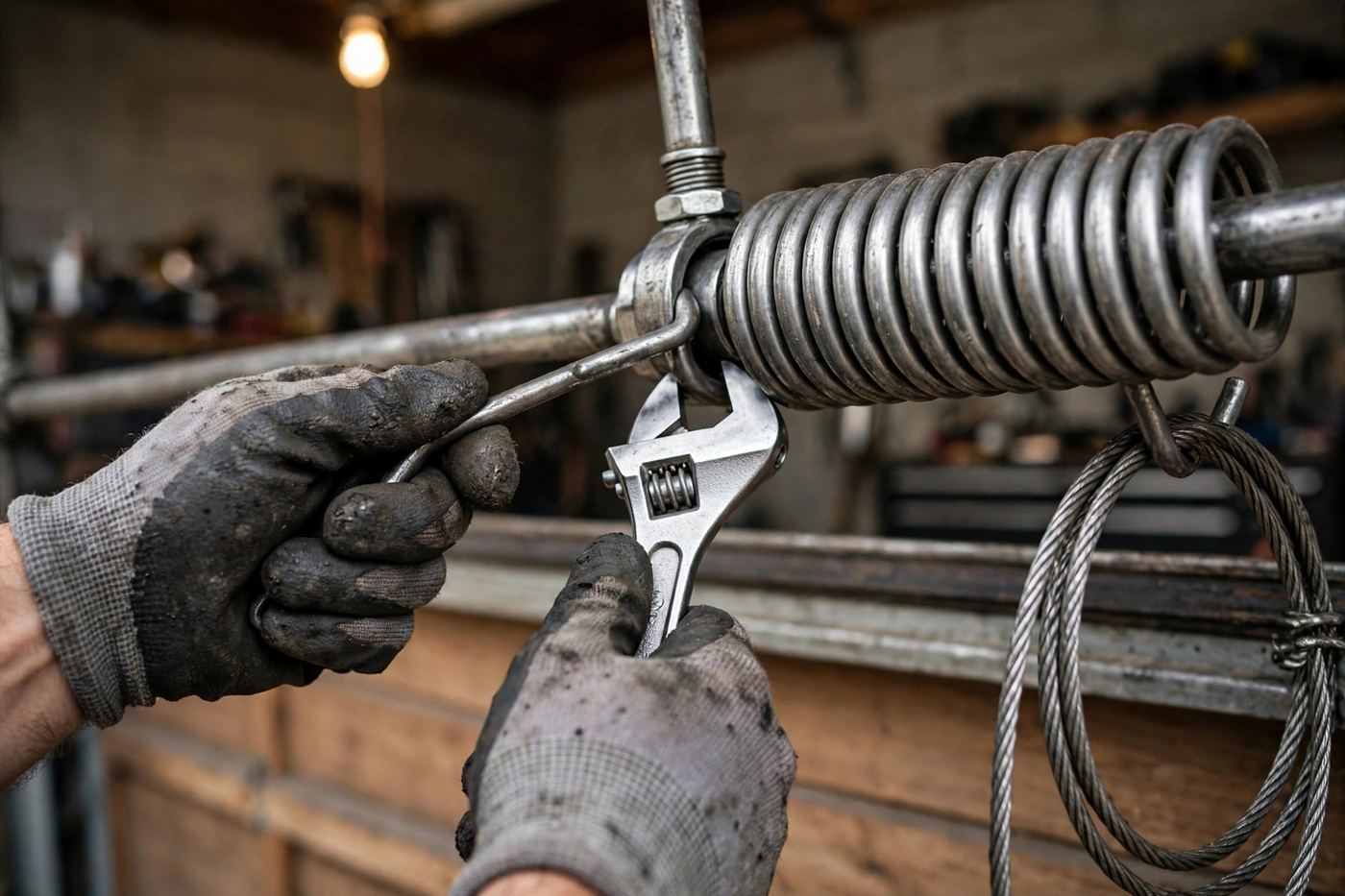
Here is the diagnosis that protects the money: disconnect the opener and lift the door by hand. Openers die young almost exclusively by lifting unbalanced doors. If your door is heavy or won't hold at halfway, the springs are the disease and the opener is a symptom — replacing the opener without fixing the balance installs a new victim.
This is also why 'the opener died twice in three years' stories exist. Balance first ($120-$350 if springs are the issue), then judge the opener on a healthy door. Many openers condemned on unbalanced doors work perfectly once the door is right.
Making the Call With Both Quotes
Ask for the repair quote and the replacement quote together, installed prices, warranties stated. Then weigh: remaining life bought by the repair (component-dependent), the feature and safety delta, and your horizon in the home. Selling within a year? Repair the cheap fault. Staying a decade? The new opener's warranty, quiet and backup usually amortize beautifully.
A trustworthy company presents both without steering theater. If the advice ever feels like it's about the ticket size rather than your door, get the second opinion — opener work is standardized enough that honest numbers cluster tightly.
The Features Audit: What Your Current Opener Lacks
Walk this list against your unit: photo-eye sensors (mandatory since 1993 — if absent, replacement isn't a preference, it's a safety correction). Rolling-code remotes (if yours predate them, your code can be captured). Battery backup (outage operation). Auto-close and phone alerts (the forgotten-door problem). LED lighting. Soft start/stop (door hardware kindness). A 15-year-old opener typically lacks four of the six; a new unit has all six for $350-$850 installed — which reframes 'repair the board for $260' considerably.
None of this argues for replacing a healthy 8-year-old opener over a gear kit. It argues for counting features as value in the comparison instead of pretending the two options — a repaired old unit and a new one — are the same product at different prices.
Installation Day: What 'Installed' Should Include
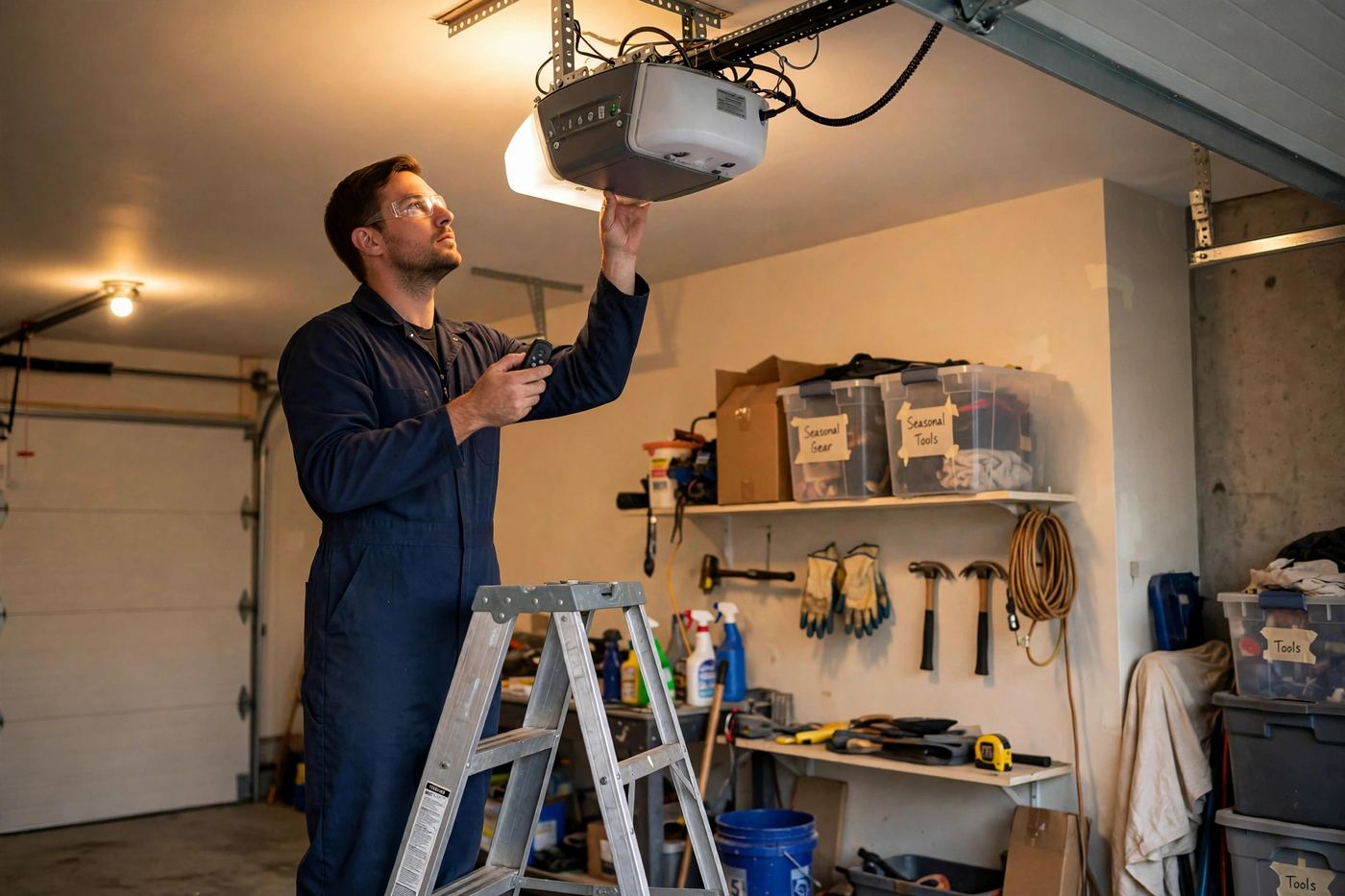
A complete opener replacement includes removal and disposal of the old unit, the new motor and rail, both safety sensors fitted and aligned, a wireless keypad programmed, remotes for your vehicles, smartphone setup if the model supports it, travel and force calibration, and demonstrated safety tests. If a quote's 'installation' is silent on sensors or disposal, it's not the same product as a full-service install, whatever the headline price says.
Also expect the door itself to be checked and balanced as part of the job — installing a new opener on an unbalanced door starts its warranty life under a handicap. Our installations include the balance correction conversation up front, so the new unit's first lift is the easy lift it was designed for.
Smart Upgrades Short of Replacement
Between 'repair it' and 'replace it' sits a middle shelf worth knowing. A plug-in smart hub ($75-$150) gives many existing openers full phone control, alerts and scheduling — most of the smart value of a new unit at a fifth of the price, provided the opener is mechanically sound. A battery-backup add-on exists for some models, though it's less universal; check compatibility before assuming. Fresh rolling-code remotes modernize the access security of any opener new enough to learn them.
What the middle shelf can't fix: a worn gear train, a tired motor, a dying board's reliability, or chain-drive noise. The upgrades add features to a healthy platform; they don't restore an unhealthy one. The decision sequence stays the same — door balance first, opener health second, features third.
If you do upgrade, do the security reset in the same sitting: erase all old codes, reprogram only current devices, set a fresh keypad PIN. New features on top of forgotten codes — the previous owner's remote, the long-moved-out teenager's PIN — are a smart door with the gate left open.
Opener Decision Matrix
| Item | Cost / Rating | Notes |
|---|---|---|
| Under 10 yrs, gear/capacitor fault | Repair | $90-$250, years of life remain |
| Under 10 yrs, board fault | Repair | $150-$300, then add surge protection |
| 10-15 yrs, single cheap fault | Repair | Sensors/capacitor only |
| 10-15 yrs, board + worn gear | Replace | The stack breaks the half-cost rule |
| 15+ yrs, any major fault | Replace | Feature & safety gap seals it |
| Pre-1993 unit, anything | Replace | No photo-eye safety system |
Frequently Asked Questions
How long do garage door openers last?
Typically 10-15 years. Chain-drive units with simple repairs often reach the top of that range; the failure that retires most openers is a logic board or motor on a unit old enough that replacement economics win.
What is the most common opener repair worth doing?
Gear kits ($120-$250) on mechanically sound units and sensor work ($85-$200) are the classic good-value repairs. Capacitors ($90-$180) are cheap and decisive. Boards ($150-$300) depend entirely on the unit's age.
Should I replace the opener when I replace the door?
Only if it fails the tests: age, condition, or sizing for the new door's weight. A healthy, compatible opener recalibrates to a new door happily. Bundling saves a little labor when both genuinely need doing.
Is battery backup worth the extra cost?
For most households, yes — outages are precisely when you most need the door (storms, evacuations, coming home to a dark house). Some states mandate it on new installations for exactly this reason.
My opener works but is very loud. Repair or replace?
If the noise is the door (rollers, balance), fix the door. If it's the chain-drive unit itself and bedrooms are nearby, a belt-drive replacement is the permanent answer — no repair makes a chain drive quiet.
Can I install a new opener myself?
Opener installation is more forgiving than spring work — the door's tension system isn't opened — and handy homeowners do it successfully with a helper and a free afternoon. The professional value is in the calibration and safety testing: force and travel set wrong are the two errors DIY installs make most, and both are invisible until they matter. If you self-install, budget the same care for the auto-reverse and sensor tests as for the mounting.
Related Services
Garage Door Opener Repair
Opener hums, clicks or runs but the door won't move? We repair motors, gears, belts, boards and sensors for all major brands.
Learn more about garage door opener repair →Garage Door Opener Installation
New opener installed and programmed — quiet belt drives, battery backup, smartphone control and wall-mount options.
Learn more about garage door opener installation →Garage Door Repair
Complete diagnosis and repair for doors that won't open, close, balance or seal — most repairs finished in a single visit.
Learn more about garage door repair →← All garage door guides · Costs & pricing hub
Garage Door Stuck? We Can Fix It Today.
Same-day appointments and 24/7 emergency service across all 50 of our service cities. Upfront price before work starts — no surprises on the invoice.
(210) 964-8892 ☎ Call Now — Open 24/7