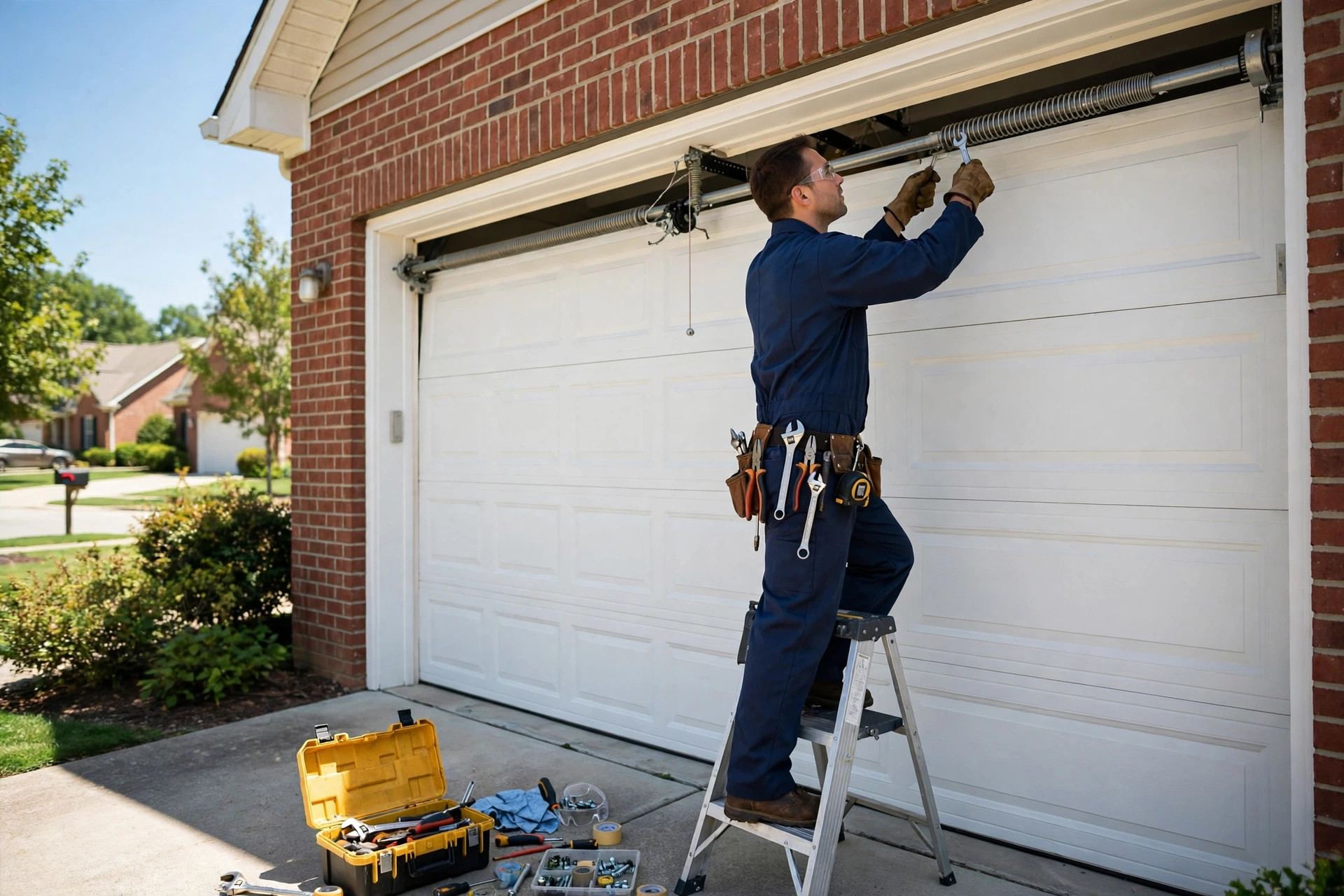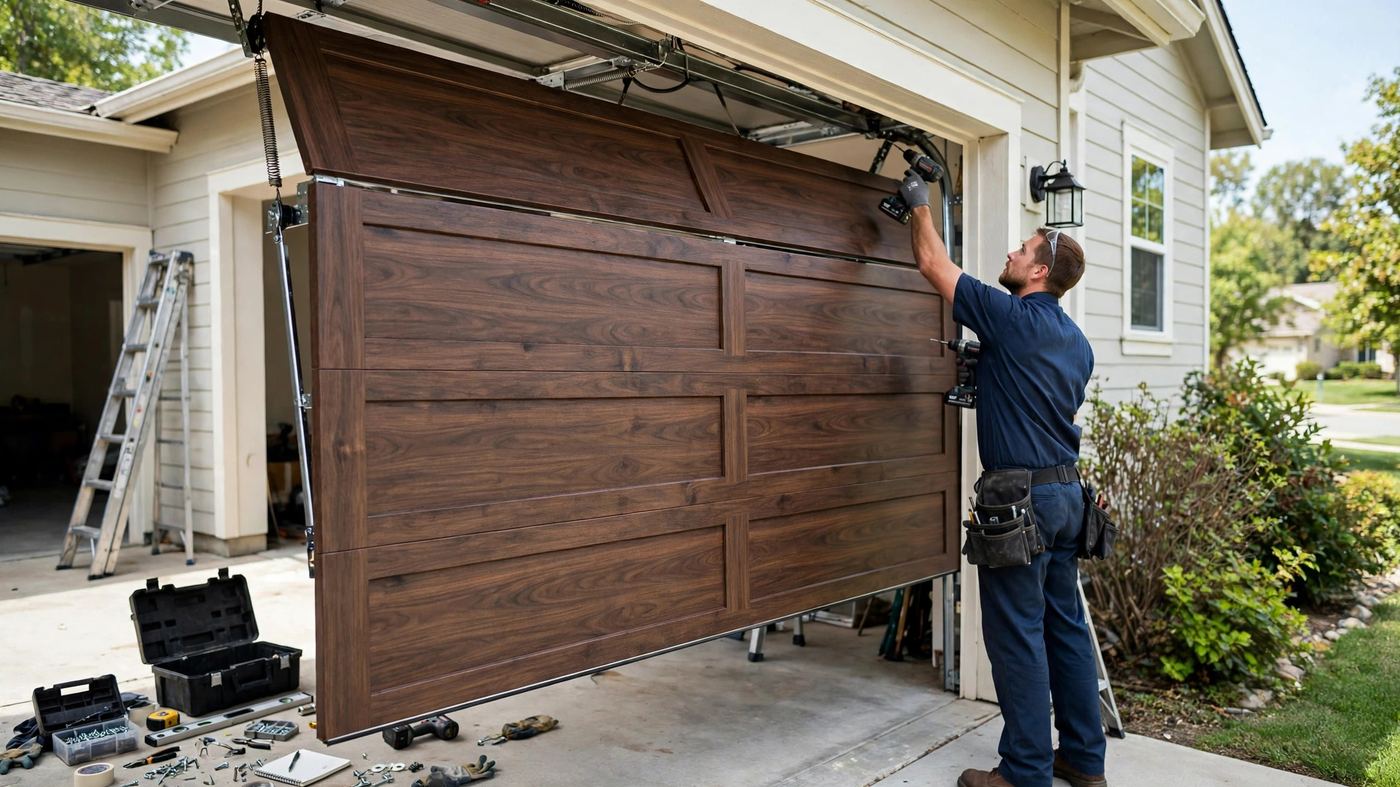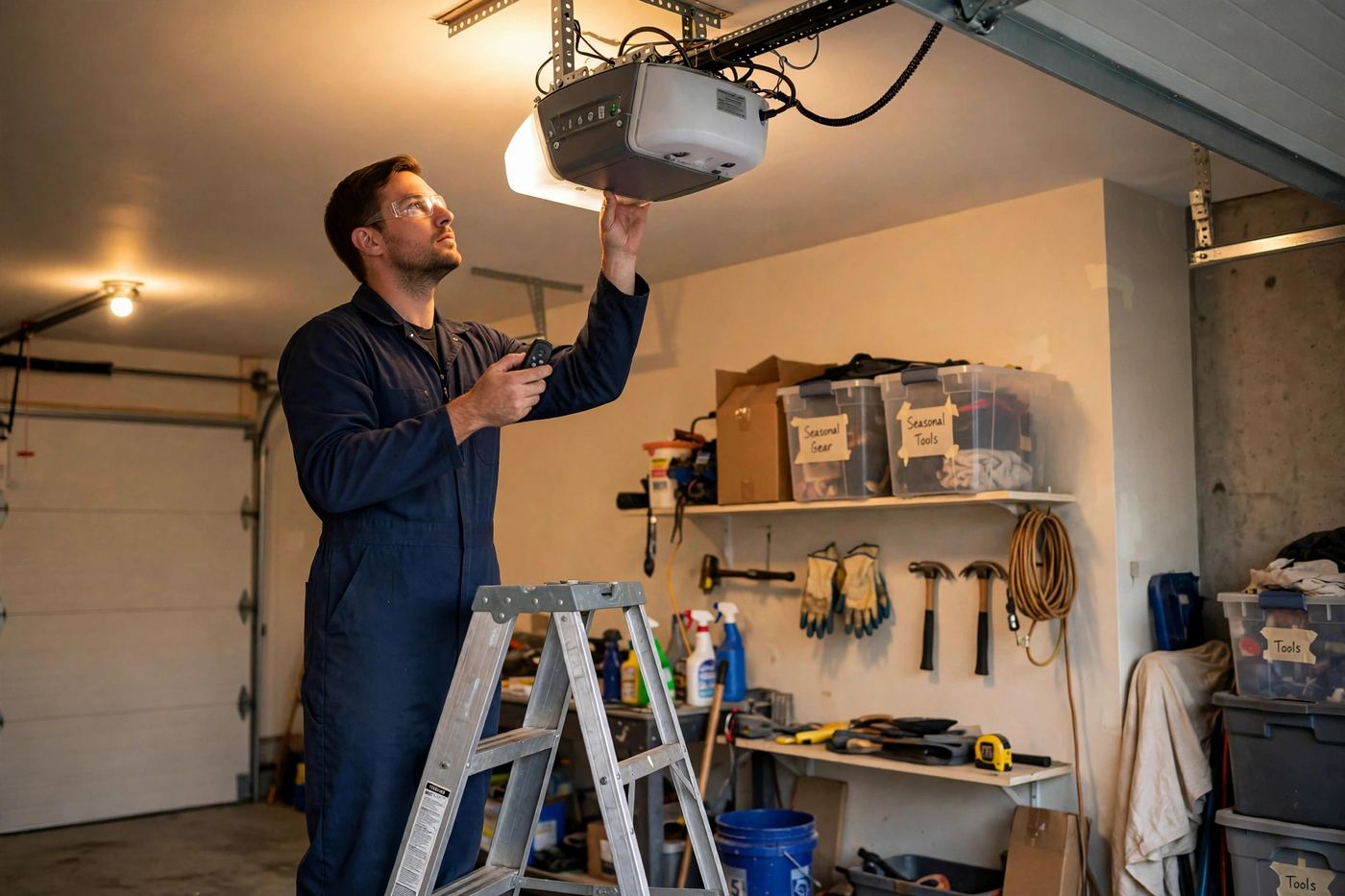
Rule one before anything else: never disconnect or tape over the safety sensors to force a door closed. Every workaround that defeats the safety system converts an inconvenience into a liability.
In This Guide
- Start With the Sensors (Cause #1, By Far)
- Obstructions, Tracks and the 'Invisible' Blockage
- Travel Limits and Force Settings
- The Balance Test: Is the Door Itself the Problem?
- When to Stop Troubleshooting and Call
- The Diagnostic Order, On One Page
- Doors That Won't Close in Winter Specifically
- Sensor Alignment, Step by Step (The Safe DIY Version)
Key Takeaways
- Photo-eye sensors near the floor on both sides must 'see' each other or the opener will refuse to close the door — or reverse it mid-travel.
- Look inside the tracks for the broom handle, garden tool, snow shovel or storage bin edge that has silently migrated into the door's path — the door may be hitting it only at one height, which is why it reverses at the same point every time.
- Openers learn two things: how far to travel (limits) and how much resistance is normal (force).
- Pull the red release cord with the door closed and lift it manually to waist height.
- Call a professional when: you see a gap in the spring above the door or a hanging cable; the door is crooked in the opening; the tracks are visibly bent; the door dropped suddenly at any point; or you've done the sensor and obstruction checks and the problem persists.
- Work the problem in cost order, because the causes are stacked that way.
- Cold adds three causes that vanish in spring: ice bonding the bottom seal to the slab (the opener reads it as an obstruction and reverses); contracted tracks and stiffened lubricant making travel resistance spike past the force setting; and a marginal spring finally failing in the cold, leaving the door too heavy for the opener to control on the way down as well as up.
- Alignment is the one sensor task firmly in homeowner territory, and here's the careful method.
How to use this guide: work the checks in the order given — they're sequenced from the most common and cheapest causes to the rarest and most involved, which is exactly how a technician's diagnosis proceeds. Stop at the step that solves it, and stop entirely at anything involving springs, cables or a door that's crooked or off its tracks: those are professional jobs, and this guide will tell you plainly when you've reached one. If you reach the end without a fix, call (210) 964-8892 and tell the dispatcher which steps you completed — you'll skip half the diagnosis and get the right parts on the first truck.
Start With the Sensors (Cause #1, By Far)
Photo-eye sensors near the floor on both sides must 'see' each other or the opener will refuse to close the door — or reverse it mid-travel. Check that both sensor lights are lit and steady. One dark or flickering light means misalignment, a dirty lens, a loose wire, or sunlight flooding one eye (a classic afternoon-only problem on west-facing garages). Wipe the lenses with a soft cloth and gently nudge the brackets until both lights hold steady.
Holding the wall button down continuously overrides the sensors on most openers and closes the door — that's a diagnostic, not a fix: if the door closes on a held button but not on the remote, the sensors are confirmed as the problem area. Professional sensor service runs $85-$200 if alignment or replacement doesn't solve it at home.
Obstructions, Tracks and the 'Invisible' Blockage
Look inside the tracks for the broom handle, garden tool, snow shovel or storage bin edge that has silently migrated into the door's path — the door may be hitting it only at one height, which is why it reverses at the same point every time. Check for a bent track section or a roller that has climbed half out of its bracket, and look along the floor line for ice, gravel or a shifted threshold.
Also inspect the door's bottom seal: a swollen, frozen or debris-packed seal can trigger the opener's force sensor at the very end of travel, making the door bounce back open the instant it touches down. If the door closes fine on some days and not others, temperature-driven track contraction and sun-on-sensor are the two weather suspects to note when you describe the problem.
Travel Limits and Force Settings
Openers learn two things: how far to travel (limits) and how much resistance is normal (force). Settings drift with age, temperature and door condition. If the door stops inches short of the floor and reverses, the down-limit may need a small adjustment; if it reverses on contact with the floor as if it hit something, force calibration is the suspect. Your opener's manual covers the dials or buttons — small quarter-turn changes only, tested between each.
But treat settings as the third check, not the first: limits get blamed for many problems that are really a binding door or dying spring making the opener work harder. If you've adjusted force upward to get a heavy door to close, you've masked the real fault and shortened the opener's life. Heavy door = door problem. See the balance test below.
The Balance Test: Is the Door Itself the Problem?
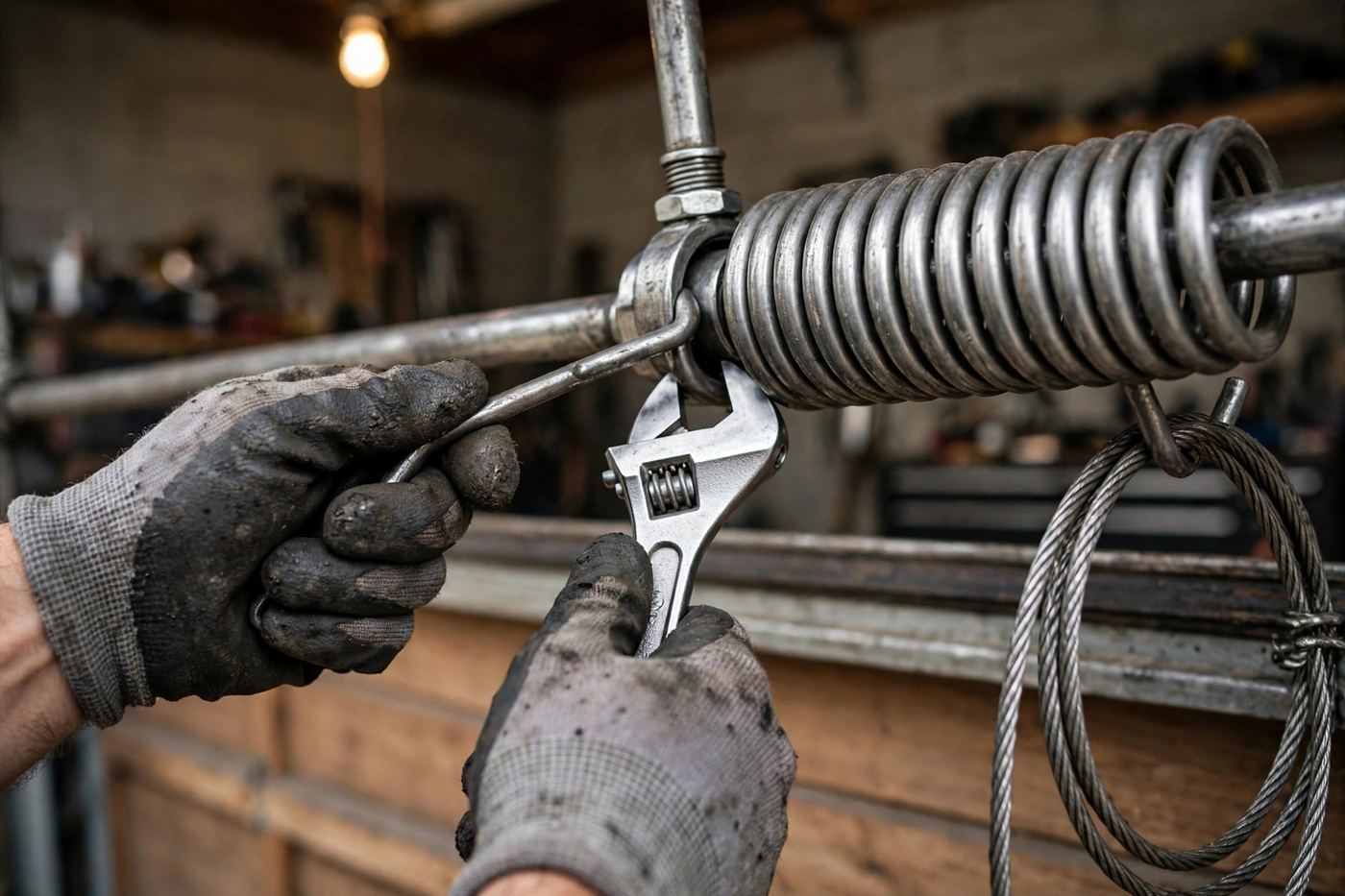
Pull the red release cord with the door closed and lift it manually to waist height. A healthy door feels light and stays where you leave it at halfway. If it slams down or needs real muscle, the counterbalance — springs — is failing, and the opener is quite reasonably refusing or failing to manage the load. Springs are a professional job, full stop: $120-$350, usually same-day.
While the opener is disconnected, roll the door through its travel by hand and feel for binding, grinding or one stiff section. Rollers that have seized or cracked announce themselves here. A door that travels smoothly and balances well but still won't close on the opener has an opener-side problem: board, capacitor or limits — the $75-$300 repair family.
When to Stop Troubleshooting and Call
Call a professional when: you see a gap in the spring above the door or a hanging cable; the door is crooked in the opening; the tracks are visibly bent; the door dropped suddenly at any point; or you've done the sensor and obstruction checks and the problem persists. Also call if the door won't close and it's night — an unsecured home justifies an emergency visit, and securing or repairing it is a routine call for us at (210) 964-8892.
Keep a note of the pattern when you call: time of day, where it stops, what the sensor lights do, and any recent changes (storm, power outage, new LED bulb in the opener — a real and surprisingly common cause of remote interference). Good information gets the right parts on the first truck.
The Diagnostic Order, On One Page
Work the problem in cost order, because the causes are stacked that way. One: sensor lights — both steady? Two: beam path — anything at ankle height crossing the opening, including the sun at the wrong hour? Three: obstruction in the tracks or a door that binds — found by watching one slow close (from inside, clear of the path). Four: the wall-button hold test — closes only while held means the safety circuit is voting no. Five: travel and force settings, adjusted in small steps per the manual. Six: the balance test, which indicts or clears the springs.
Six checks, fifteen minutes, and you've either fixed it or isolated it to a component a technician can price. The failure mode to avoid is random part-swapping — new sensors on a misaligned bracket, a new board for a sun problem. Sequence is the whole secret.
Doors That Won't Close in Winter Specifically
Cold adds three causes that vanish in spring: ice bonding the bottom seal to the slab (the opener reads it as an obstruction and reverses); contracted tracks and stiffened lubricant making travel resistance spike past the force setting; and a marginal spring finally failing in the cold, leaving the door too heavy for the opener to control on the way down as well as up.
Defrost the seal bond gently, keep tracks ice-free, and treat any door that starts winter misbehavior as a tune-up candidate rather than a settings problem. Adjusting force upward to bully a cold-stiff door through January is how openers die in February.
Sensor Alignment, Step by Step (The Safe DIY Version)
Alignment is the one sensor task firmly in homeowner territory, and here's the careful method. With the door closed and the opener unplugged, loosen the wing nut on the misbehaving sensor's bracket just enough to move it by hand. Have a helper watch the receiving sensor's light while you nudge the bracket in small movements until the light burns steady and bright — flicker means you're at the beam's edge, so keep going until it's solid from a step back.
Snug the nut without shifting the bracket, plug in, and test: close the door fully, then test the auto-reverse with a paper-towel roll, then the beam-break test with your hand. All three must pass. If alignment won't hold — the light drifts within days — the bracket itself is bent or the sensor is dying, and you've reached the edge of the DIY map: that's an $85-$200 professional visit, sensors included.
Write the date on a piece of tape inside the bracket when you're done. If realignment becomes a monthly ritual, the tape tells the story: something is moving — a settling bracket, a vibrating mount, a settling slab — and the fix belongs at that level, not at the sensor.
Won't-Close Causes by Symptom Pattern
| Item | Cost / Rating | Notes |
|---|---|---|
| Reverses immediately, lights blink | Sensor beam interrupted | Clean/realign sensors |
| Reverses at the same height daily | Track obstruction or bind | Inspect tracks at that height |
| Fails only on sunny afternoons | Sun-blinded receiver | Shade or swap sensors |
| Bounces at the floor | Down-limit or seal issue | Adjust limit; check bottom seal |
| Closes on held wall button only | Safety circuit fault | Sensor/wiring service ($85-$200) |
Frequently Asked Questions
Why does my garage door go down a few inches and come back up?
The sensors are the top suspect — something is breaking or confusing the beam — followed by an obstruction in the track and travel-limit drift. Check sensor lights first: one flickering light tells you which side to clean and realign.
Can I close the door manually tonight and fix it tomorrow?
If the door is balanced and on its tracks, yes: pull the release, lower it slowly by hand, and lock it if it has a manual lock. If it's heavy, crooked or has a broken spring, don't force it — call for emergency service instead.
The sensor lights are on but the door still won't close. Now what?
Check for a steady (not flickering) light — flicker means marginal alignment. Then check track obstructions and try the wall-button hold test. Persistent faults point to wiring, a failing sensor or the opener board: a service call item.
Why does my door only fail to close in the afternoon?
Sunlight flooding a photo-eye is the classic pattern on sun-facing garages. Shading the receiving sensor or swapping sensor positions fixes it; a technician can also fit sun-resistant sensors.
Is it safe to disconnect the sensors temporarily?
No. The sensors and auto-reverse are the systems that prevent a closing door from injuring a child or pet. Defeating them — even 'just for tonight' — is exactly how accidents happen. Close the door manually or call for service.
My door closes but then opens again on its own — 'ghost opening.' What is it?
Usually a signal problem, not a ghost: a neighbor's remote on a shared code (older fixed-code openers), a stuck remote button in a drawer or visor, or a failing board. Erase and reprogram all codes first; if it persists, note the times — patterns point to the source.
Related Services
Garage Door Repair
Complete diagnosis and repair for doors that won't open, close, balance or seal — most repairs finished in a single visit.
Learn more →Garage Door Opener Repair
Opener hums, clicks or runs but the door won't move? We repair motors, gears, belts, boards and sensors for all major brands.
Learn more →Garage Door Maintenance & Tune-Up
A full tune-up: balance test, lubrication, hardware tightening, sensor and safety checks — the cheapest way to avoid a breakdown.
Learn more →← All garage door guides · Costs & pricing hub
Garage Door Stuck? We Can Fix It Today.
Same-day appointments and 24/7 emergency service across all 50 of our service cities. Upfront price before work starts — no surprises on the invoice.
(210) 964-8892 ☎ Call Now — Open 24/7